



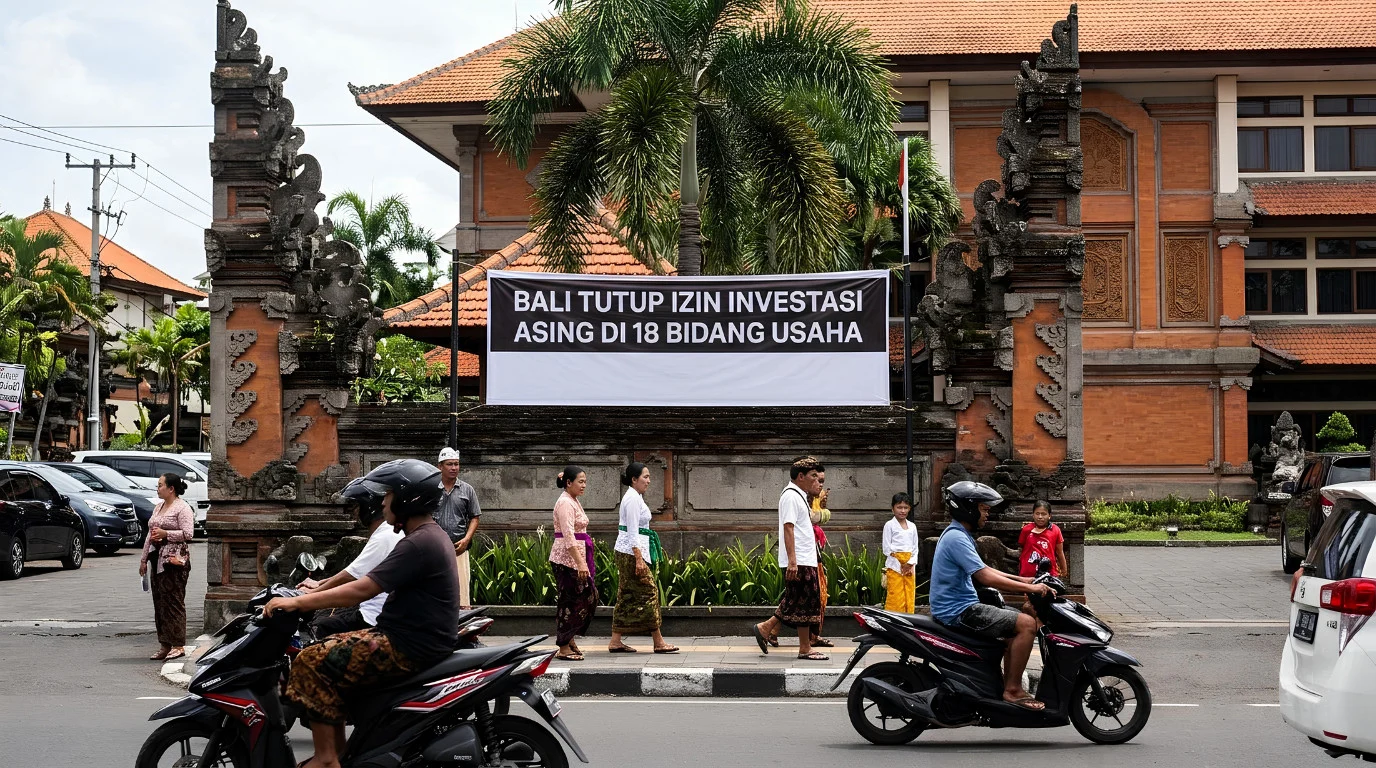
The Bali Provincial Government has officially closed access to foreign investment (PMA) licensing in 18 business sectors. The policy was introduced to protect micro, small, and medium-sized enterprises (MSMEs) from what is considered unfair business competition.
Bali Governor Wayan Koster said the restrictions were implemented by deactivating access to the Online Single Submission (OSS) system for 18 Indonesian Standard Industrial Classification (KBLI) codes categorized as low and medium-low risk. The policy followed an evaluation conducted by the Bali Provincial Government of foreign investment business licensing.
The evaluation identified indications that foreign investors were using the risk-based licensing system to enter business sectors that have traditionally been areas of opportunity for local communities. “The Bali Provincial Government’s licensing evaluation team sought to identify indications of foreign investors using the risk-based business licensing system to enter business sectors related to MSMEs,” Koster said in Denpasar, as reported by Kompas.com on Thursday (July 23, 2026).
According to Koster, some foreign investors had taken advantage of loopholes in the OSS system by registering their businesses under low-risk categories, which only require a Business Identification Number (NIB). This mechanism allows businesses to obtain licensing automatically without being required to obtain standard certificates or additional permits.
He said this situation had allowed foreign investment companies to enter business sectors that directly compete with MSMEs, with some even using virtual offices. “This situation has the potential to create unfair business competition and place significant pressure on the sustainability of local businesses, particularly MSMEs, in sectors that should instead encourage partnerships with cooperatives and MSMEs,” he said.
After receiving approval from the Minister of Investment and Downstream Industry/Head of the Investment Coordinating Board (BKPM), the Bali Provincial Government proceeded to close OSS access for the 18 business sectors. The restricted sectors include small-scale hotels, real estate, car and motorcycle rentals, retail trade in clothing and textiles, food retail, accommodation services, drinking establishments and cafés, tailoring services, fitness centers, sports facilities, sports event promoters, and management consultancy services.
Koster said the OSS restrictions had been implemented across Bali since the third week of May 2026. Under this policy, foreign investors can no longer submit new business license applications through the OSS system for the 18 restricted business sectors until further policy decisions are issued.
Companies that are already operating, however, are still required to submit Investment Activity Reports (LKPM) until the relevant KBLI codes are deactivated or removed from the licensing system. Koster emphasized that the regional government would take firm action against any licensing violations.
Nevertheless, Bali remains open to high-quality and responsible investment that contributes to the regional economy. “Investments entering Bali are expected to align with Bali’s development vision, respect local wisdom, and support the strengthening of a people-centered economy based on MSMEs,” Koster said.